This startup thinks robotics is about to have its ChatGPT moment
Digital Frontier EditorialJuly 8, 20265 min read
Key Takeaways
General Intuition raised $320M at a $2.3B valuation betting that robotics will follow LLMs' foundation-model trajectory
The startup trained on millions of hours of video game data, not robot teleoperation, to build spatial-temporal reasoning
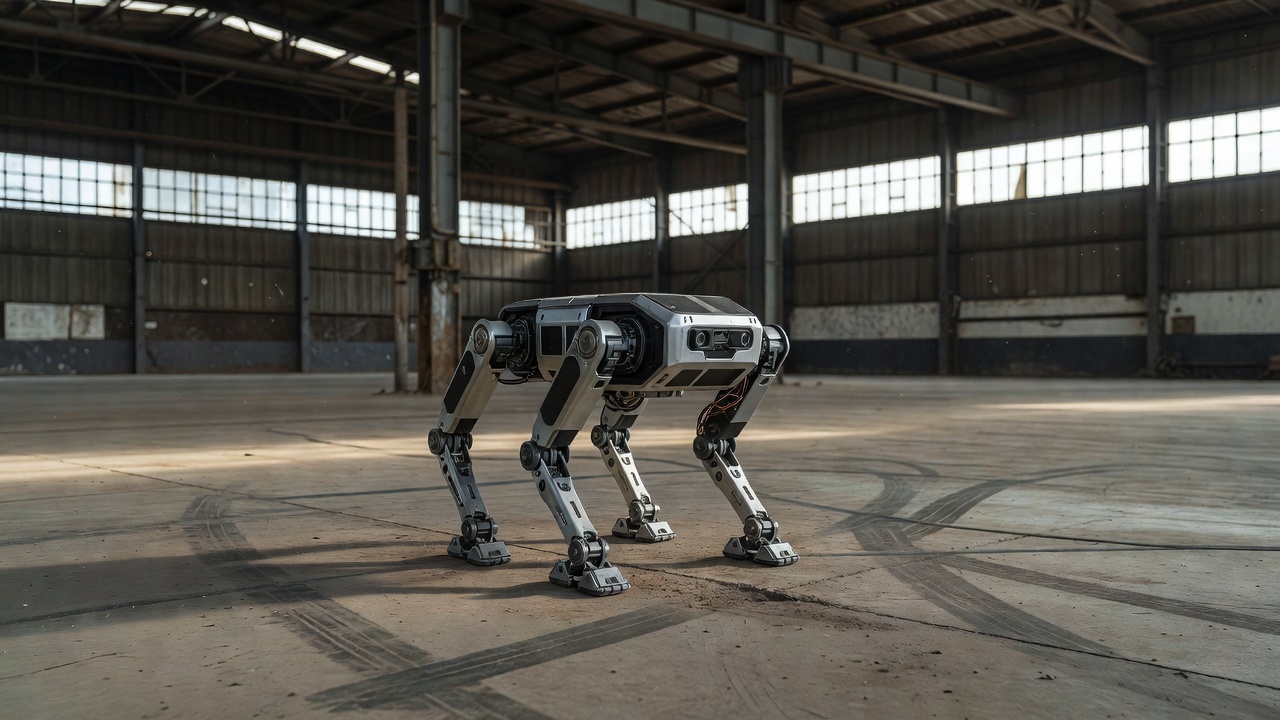
Their model powered a quadrupedal robot after just eight minutes of real-world fine-tuning — zero-shot on a single camera
CEO Pim de Witte wants to become the "GPT of physical AI," not build robots themselves
The robotics industry is burning millions of hours collecting bespoke teleoperation data. General Intuition thinks that's about to look as quaint as training a BERT from scratch in 2023.
Pim de Witte, the company's CEO, draws a straight line from today's robotics labs to pre-GPT-3 NLP. Back then, every sentiment classifier and named-entity recognizer needed its own labeled corpus. Then foundation models arrived. Now you prompt Claude. De Witte argues embodied AI will take the same turn: stop hoarding robot-specific datasets, start building models that transfer intuition about movement across any body, any environment.
"A lot of companies right now are doing lots of specialized work focused on individual embodiments, individual environments, and individual robots," de Witte told TechCrunch. He predicts that work becomes redundant the moment a genuine foundation model for physical reasoning exists.
The data that isn't robot data
General Intuition's bet is counterintuitive. They didn't train on robot demonstrations. They trained on millions of hours of video game playthroughs — controller inputs, timestamps, screen pixels. The thesis: action data from humans navigating virtual worlds teaches spatial-temporal reasoning better than teleoperation teaches robot control.
Vinod Khosla, the lead investor, backs that claim. The argument rests on a distinction: teleoperation demonstrates how to operate a specific robot. Gameplay demonstrates how an agent reasons about space, time, and consequence. One is morphology-dependent. The other might transfer.
Skepticism is warranted. Video game physics are forgiving. Controllers have discrete inputs. Real robots have continuous actuation, compliance, contact forces, sensor noise. The sim-to-real gap has swallowed weaker transfer promises before.
Eight minutes
The proof point de Witte cites: their model, after pre-training on game data, powered a quadrupedal robot in an office environment after eight minutes of real-world fine-tuning. Single front camera. No lidar, no IMU fusion, no privileged state. Dynamic obstacles. People walking through.
"The fact that [the robot] was actually able to zero-shot on just the front camera... was a very big surprise to us," de Witte said.
Eight minutes is a staggering claim. If reproducible, it rewrites the economics of robotics deployment. Today, a new robot form factor in a new environment means months of data collection. Eight minutes means you ship the model, not the dataset.
But one demo in one office on one quadruped is not a scaling law. The video game corpus likely contains priors that align suspiciously well with legged locomotion — gravity, momentum, obstacle avoidance. Would eight minutes hold for a manipulator stacking dishes? A drone threading a forest? A surgical snake robot? The transfer breadth remains unproven.
Platform play, not product play
De Witte is clear: "We're not gonna build a self-driving car company. We're gonna make it 10 times easier for the next person to build a self-driving car company."
That positions General Intuition as an infrastructure layer — the GPT, not the Copilot. The business model only works if the model genuinely generalizes. If every robotics company still needs to collect 10,000 hours to adapt it, the "foundation" label is marketing.
The $2.3 billion valuation says investors believe the generalization will hold. Khosla Ventures has backed long-horizon hard tech before. But the robotics graveyard is littered with "general" controllers that folded when contact got messy.
The ChatGPT analogy has limits
Language models had a secret weapon: the internet. Trillions of tokens of diverse, high-quality text, free for the scraping. Robotics has no equivalent. Video game data is clever proxy, but it's still proxy. The distribution shift from pixel-space to joint-torque space is not a fine-tuning problem — it's a domain adaptation problem of unknown difficulty.
Also, language is discrete. Motor control is continuous, high-frequency, safety-critical. Hallucination in text is embarrassing. Hallucination in a 80kg quadruped is litigation.
De Witte knows this. "The generalization of the model itself is the product," he said. "The fact that it has a base level of reasoning about space and time is going to be the reason why people stop collecting hundreds of thousands or millions of hours of real-world data. Because the reality is, you only need a few minutes."
What happens next
If General Intuition is right, the robotics stack inverts. Companies stop hiring teleoperation fleets. They start prompting foundation models with task descriptions and a handful of calibration rollouts. The competitive moat shifts from data volume to prompt engineering, safety verification, and hardware integration.
If they're wrong, the $320 million bought a very expensive video game bot.
The industry will know within 18 months. Foundation models don't hide — they either generalize or they don't. Robotics companies will try to build on General Intuition's API, or they won't. The market adjudicates fast.
De Witte's timeline is aggressive. He's not promising AGI. He's promising that the era of per-robot, per-environment datasets ends. That's a falsifiable claim. Respect.