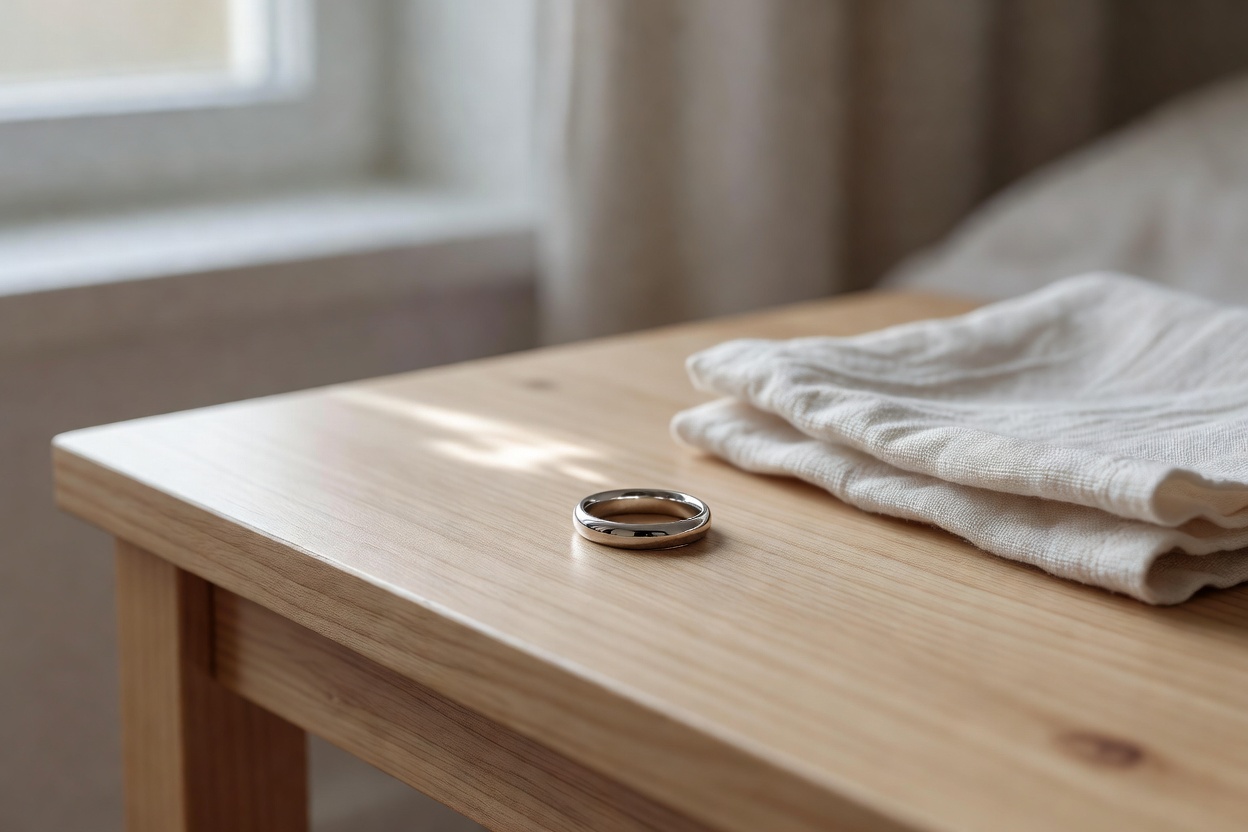
The ring that finally disappears
There's a moment, usually around week three of testing a wearable, when you forget it exists. Not the "I forgot to charge it" way — the "I forgot I'm wearing a computer on my body" way. The Oura Ring 5 hit that mark for me on day twelve, somewhere between a deadline crunch and a 6 a.m. flight to Seattle. I washed my hands, typed three thousand words, slept in a hotel bed that definitely hadn't seen a fresh sheet since the Obama administration, and never once adjusted the thing.
That's the review. Everything else is noise.
The thinness is the feature
Tech journalism has trained us to hunt for spec sheet deltas. New sensor? Check. Faster processor? Check. AI-powered hopefully-not-hallucinated insights? Double check. But the Ring 5's genius isn't in what it adds — it's in what it subtracts. Forty percent thinner than the Ring 4. Four-point-one millimeters at its thickest point. That number soundsabstract until you wear a Ring 4 for a year, then swap to a Ring 5, and suddenly understand why your knuckle skin has been quietly resenting you.
I saw a woman on the Q train last month wearing a Ring 4. Couldn't stop staring. The thing looked like a piece of industrial equipment strapped to her finger — chunky, obvious, present. Two years ago I would've called it sleek. Now it looks like a prototype. That's how fast the goalposts move when a company actually nails the form factor.
Oura didn't invent the smart ring. They just invented the one you'd actually wear.
Same guts, different conversation
Here's where the purists will groan: the sensor suite is virtually identical to the Ring 4. Same green/red/IR LEDs, same temperature sampling, same accelerometer. The "new" features — GLP-1 medication tracking, cardiovascular age estimates, a slightly expanded readiness algorithm — are software. Firmware. App updates that could've (and arguably should've) landed on last year's hardware.
And the subscription. The subscription. Six dollars a month, forever, for insights that Apple Health and Google Fit increasingly give away for free. Oura knows this. They're betting you'll pay for the polish — the cohort comparisons, the trend lines that don't look like a spam folder, the "readiness score" that's become shorthand for "should I skip leg day?" among a certain demographic of tech-adjacent thirty-somethings.
I paid it. I'll keep paying it. Not because the data is unique, but because the presentation respects my time.
The battery lie we tell ourselves
Seven days. That's the claim. I got six and change with daily SpO2 tracking enabled. The Ring 4 managed five. An extra day sounds trivial until you're packing for a weeklong trip and realize you can leave the charger at home. That's the whole ballgame. Wearables should charge while you sleep, not while you're hunting for an outlet in a conference center.
The charging puck is unchanged. Still fiddly. Still requires the exact rotational alignment of a naval gun turret. Still the weak link in an otherwise invisible experience.
Sizing remains the silent killer
Order the free sizing kit. Wear the plastic dummy rings for 24 hours. Sleep in them. Shower in them. Ignore this advice and you'll join the Reddit threads of people whose $350 rings spin like loose change or cut off circulation at 3 a.m. Oura's sizing algorithm is decent but not magic. Human fingers swell, shrink, and betray you seasonally. The Ring 5's thinner profile helps — less surface area means less friction — but it's not a solve.
I went size 10. Should've gone 10.5. My right hand swells after salty takeout; the ring becomes a tourniquet. This is not Oura's fault. It is biology's fault. But it's the reason I still hesitate to recommend smart rings universally.
The Apple comparison writes itself
Everyone wants to call this the "iPhone Air moment" for smart rings. The comparison is lazy but not wrong. Apple spent years convincing us that thinner is better, until the MacBook Air lost ports and the iPhone 6 bent in pockets. Oura faces the same trap: chase thinness too far and you lose battery, durability, sensor contact. The Ring 5 feels like the stopping point. Any thinner and you'd need a new battery chemistry that doesn't exist yet.
Samsung's Galaxy Ring is thicker. Circular's Ring Slim is thicker. Ultrahuman's Ring Air is thicker. Oura has effectively moated the form factor. The competitors are now fighting for second place in a category Oura defined.
Software that knows when to shut up
The app's redesign gets buried in spec lists. It shouldn't. Oura reorganized the home screen around "Today" cards — readiness, sleep, activity, resilience — with progressive disclosure. Tap once for the score. Tap twice for the breakdown. Tap three times for the raw data. No hamburger menus. No settings buried five layers deep. It's the first health app I've used that feels designed by someone who actually uses health apps.
The GLP-1 tracking module is niche but thoughtful. Tag your injection day, log side effects, correlate with sleep and HRV trends. For the millions on semaglutide, it's a dedicated workspace. For everyone else, it's invisible. That's the model: features that appear when needed, vanish when not.
Worth the upgrade tax?
Fifty bucks more than the Ring 4 at launch. Same subscription. If you own a Ring 4 that fits and charges fine? Stay put. The sensor parity is real. The software updates will trickle down. But if you're buying your first smart ring, or your Ring 3 is dying, or you sized wrong and have been suffering — the Ring 5 is the one. The thinness isn't a luxury. It's the difference between a device you wear and a device you endure.
I've worn the Ring 5 for thirty-one days. Charged it four times. Forgot it existed for twenty-seven of them. That's not a spec. That's the product.
The best wearable is the one you stop noticing. Oura finally built it.