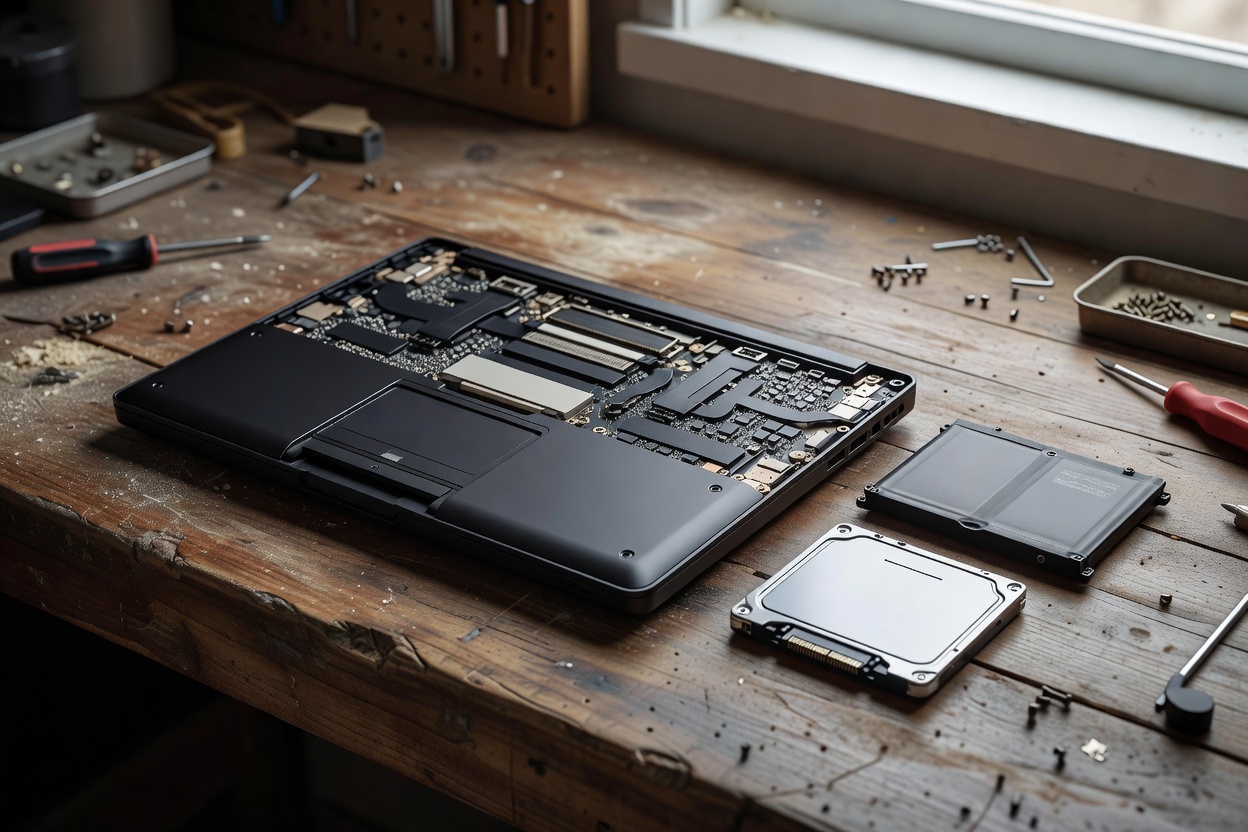
The last time I felt genuine excitement about a laptop's interior, it was 2012. I was prying open a ThinkPad T420, marveling at a machine that treated its owner like a competent adult. Two RAM slots. A socketed CPU. A battery you could eject with a latch. A keyboard held by three screws and a prayer. You didn't need a heat gun, a spudger, and a degree in micro-soldering to keep the thing alive. You needed a Phillips #0 and ten minutes.
Then the industry collectively decided that thin was the only metric that mattered. Soldered memory. Glued batteries. Proprietary SSDs. Keyboards riveted into the chassis. If a $2,000 ultraportable died because a $15 charging port failed, you bought a new laptop. Planned obsolescence wasn't a conspiracy; it was the business model. And we — reviewers, IT buyers, enthusiasts — mostly shrugged and adjusted our scores.
So when I lifted the bottom cover off Lenovo's 14th-generation ThinkPad X1 Carbon at CES 2026, I didn't expect to feel that old thrill. I expected the usual theater: a few captive screws, a glued battery, a motherboard buried under a heat pipe labyrinth. Instead, I found the "Space Frame."
What the Space Frame Actually Changes
Let's be precise about what Lenovo built. The Space Frame is a double-sided motherboard mounted to a magnesium skeleton that doubles as the structural spine. Flip the laptop over, remove five standard Phillips screws — no Torx, no pentalobe, no adhesive — and the entire bottom panel lifts away. Right there: the battery, connected by a cable, not glue. The USB-C ports on individual daughterboards. The keyboard, held by screws accessible from the top once you pop the trackpad module. The SSD in a standard M.2 slot. The Wi-Fi card, socketed.
iFixit gave it a 9/10. That's not a typo. A flagship ultraportable from a top-three OEM scored a 9/10 in 2026. The last time a mainstream business laptop hit that mark, Barack Obama was in his first term.
The repair procedure for a failed USB-C port — historically a motherboard replacement costing $600+ in parts and labor — now involves unplugging a $12 daughterboard. A keyboard swap takes twelve minutes. I timed it. The battery? Two minutes. This isn't modularity as marketing slideware. It's modularity as engineering discipline.
The ThinkPad Legacy, Reclaimed
There's historical weight here. The ThinkPad brand built its reputation on exactly this: machines designed for the field, not the showroom. The 701C butterfly keyboard. The T60's roll cage. The X200s with its user-replaceable everything. Lenovo earned enterprise trust by treating IT departments as partners, not adversaries.
Somewhere after the X1 Carbon Gen 1, that DNA attenuated. The pursuit of MacBook Air thinness — and the margins that come with sealed, non-upgradeable designs — infected the line. Soldered RAM became standard. Batteries glued. The "Carbon" name stayed, but the philosophy hollowed out.
The Gen 14 doesn't fully resurrect the golden era. The RAM is still soldered. 64GB LPDDR5x is your ceiling, forever. Lenovo acknowledges this could change in future models, but "could" does a lot of heavy lifting in product roadmaps. For power users who keep machines five years, that's a real constraint. Chrome tabs don't get lighter. Local LLMs don't get smaller.
But the company made a calculated, meaningful choice: they prioritized the components that fail most often. Ports. Keyboards. Batteries. Fans. The things that turn a three-year asset into e-waste. They left the RAM soldered — a genuine disappointment — but they gave us a machine where the rest of the bill of materials is serviceable. That's not perfect. It's pragmatic. And in this industry, pragmatic is revolutionary.
Enterprise Gets It First — And That Matters
Cynics will note that Lenovo's primary customer for this design isn't you. It's the CIO managing 5,000 endpoints. A keyboard replacement that once required a depot visit and a three-day turnaround now happens at a desk by a tier-1 tech. A port failure doesn't trigger a motherboard RMA. The total cost of ownership math shifts dramatically when "repairable" means "repairable by my staff, tomorrow."
But here's the thing: enterprise demand is the only thing that moves the needle for consumer repairability. Framework proved a niche market exists. Apple's Self Service Repair program exists because regulators forced it. Lenovo putting this in the X1 Carbon — the halo product, the executive jewelry — signals that repairability isn't a budget SKU feature. It's a premium feature. That perception shift matters.
The Right-to-Repair Benchmark
We're past the point where "user-replaceable SSD" deserves a press release. The bar is higher now. The Space Frame clears it by designing for disassembly, not just access. Cables have strain relief. Connectors are keyed. Screws are captive. The service manual — which Lenovo publishes publicly, without login walls — reads like it was written by people who've actually turned screws.
This should be the baseline for every laptop over $1,000. Not an aspiration. The baseline.
Faith, Restored — With Reservations
I've tested dozens of laptops since that T420. Most left me cynical. The X1 Carbon Gen 14 left me angry — angry that we accepted so little for so long. Angry that it took a 9/10 iFixit score to feel like news instead of normal.
But the machine is real. It works. It's thin (14.9mm), light (986g), and doesn't compromise on the premium experience: 2.8K OLED, haptic trackpad, 64GB RAM, Intel Core Ultra Series 2. You don't trade performance for repairability. You just get both.
The soldered RAM keeps me from calling this a total victory. But it's the first time in over a decade that a flagship business laptop made me believe the industry remembers how to build for longevity. Not "sustainability" as a slide deck. Longevity as a mechanical reality.
If Lenovo brings this architecture to the T-series and P-series — the workhorses — the calculus changes for every IT buyer on the planet. And if competitors feel pressure to match it? We might finally stop treating laptops as disposable.
That's not faith restored. That's a down payment. But it's the first honest one I've seen in a very long time.