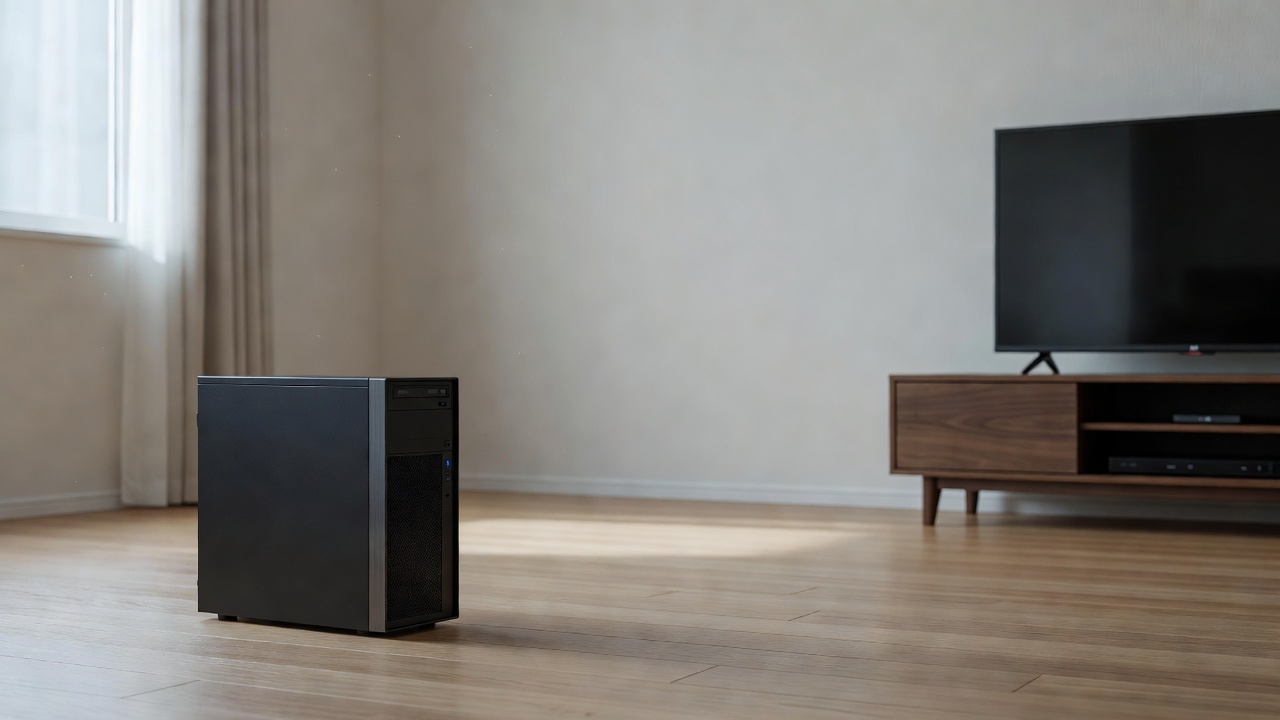
GTA 6 Would Probably Run on the Steam Machine
The internet has spent months dissecting the Steam Machine's $1,049 price tag and its benchmark deficit against the PlayStation 5. The consensus is loud, dismissive, and — as usual — missing the forest for the teraflops. Everyone's asking whether Valve's little box can muscle through the next big thing. They should be asking whether the next big thing knows how to scale down. If Rockstar's recent track record means anything, Grand Theft Auto 6 won't just run on the Steam Machine. It'll run on a toaster if you ask it nicely.
The Hardware Obsession Is a Category Error
Let's stipulate the obvious: the Steam Machine isn't a raw power monster. It's a compact, APU-driven box targeting 1080p/60 in modern titles, often landing a few frames behind Sony's console. On paper, that looks like a liability for a game positioned as the technical showcase of the decade. But paper doesn't render frames. Engineering does.
Rockstar's last two PC releases — Red Dead Redemption 2 and the GTA V Enhanced Edition — aren't just "good ports." They're masterclasses in dynamic scaling. RDR2 doesn't ship with three preset tiers and a prayer. It hands you a spreadsheet of knobs: texture streaming budgets, reflection quality per surface type, shadow cascade counts, volumetric cloud resolution independent of particle density. You can cripple the renderer until it looks like a PS2 game, or you can feed it a 4090 and watch it swallow 24GB VRAM without burping. The Vulkan backend doesn't hurt either — it strips away the D3D12 driver overhead that chokes midrange cards on Windows.
This isn't accident. It's philosophy. Rockstar North builds worlds that stream. The engine doesn't care about your theoretical peak throughput; it cares about sustained memory bandwidth and latency hiding. That architecture scales downward far more gracefully than the "ultra preset or bust" design plaguing so many Unreal Engine 5 showcases.
The Console-First Delusion
Strauss Zelnick's Bloomberg interview revealed the real bottleneck: not silicon, but corporate inertia. Take-Two's CEO acknowledged PC now drives ~50% of sales for major releases — then doubled down on the console-first cadence that delayed GTA V's PC port by two years and RDR2's by one. "Core audience" is executive speak for "where the marketing deals live."
Here's the irony: the Steam Machine is a console. It boots into a gamepad UI, runs a curated OS, and targets a fixed spec. If Rockstar can optimize for the PS5's unified memory and custom I/O complex, they can optimize for a known AMD APU with 16GB shared RAM. The delta isn't architecture — it's willingness.
And willingness is evaporating. Baldur's Gate 3 launched day-and-date on PC and PS5. Cyberpunk 2077's redemption arc was written on PC first. Alan Wake 2 skipped discs entirely. The "PC later" model survives only at Rockstar and a few Japanese holdouts — and even Square Enix is cracking. Zelnick's 50% figure isn't a prediction. It's a confession that leaving money on the table is now policy.
Scalability Is the New Exclusivity
We've been trained to read "minimum specs" as a gate. Rockstar reads them as a floor. RDR2's minimum spec — a GTX 1060 6GB / RX 580 — was a midrange card from 2017. The Steam Machine's 780M integrated graphics sits roughly between a desktop 1050 Ti and 1650 in rasterization, with significantly better bandwidth and compute. Vulkan levels the field further. There is zero technical reason GTA 6 couldn't target 1080p/30 on that hardware with "Low" settings that still exceed console visual fidelity in draw distance and population density.
The real question isn't "can it run." It's "will Rockstar bother to validate it."
The Steam Machine Doesn't Need GTA 6. GTA 6 Needs the Steam Machine.
Valve's box is a proof of concept: PC gaming without Windows tax, without driver roulette, without the enthusiast gatekeeping that keeps "core audience" rhetoric alive. If GTA 6 launches on PC — whenever that happens — and runs well on the Steam Machine, it proves the platform's viability better than any benchmark suite. It tells publishers: your engine scales, your audience is here, your excuses are expired.
Rockstar's history suggests they'll deliver the scalability. Their leadership suggests they'll delay the opportunity. The Steam Machine will sit there, ready, waiting, a $1,049 invitation to the 50% of revenue Zelnick knows exists.
The joke isn't that the Steam Machine might run GTA 6. The joke is that anyone's surprised.