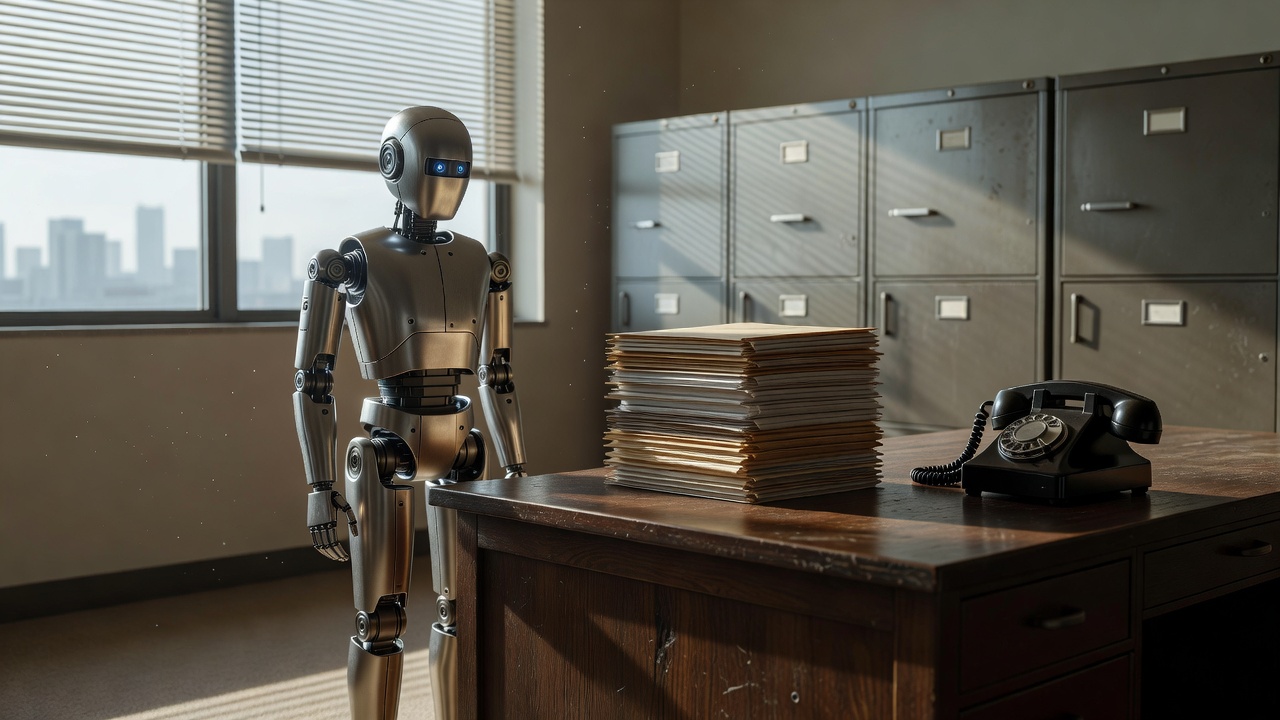
This Humanoid Robot Is a Terrifyingly Competent Office Intern
The video is deceptively mundane. A beige-and-black Unitree humanoid — let's call it what it is, a Chinese hardware platform wearing a Swiss brain — navigates an office corridor, summons an elevator, retrieves a parcel from a mailroom, and unpacks snacks into a drawer. No backflips. No parkour. No dancing to K-pop. Just a robot doing the kind of grunt work that makes up 90% of an intern's first month.
That's exactly why it's terrifying.
Flexion Robotics, spun out of Nvidia's robotics labs by Nikita Rudin, isn't chasing the Boston Dynamics spotlight. They're chasing the boring stuff. The stuff that doesn't make demo reels but makes payrolls. Opening doors. Climbing stairs. Understanding that "the snack drawer on the shelf in the snack area" requires semantic parsing, spatial reasoning, and a chain of physical skills stitched together without a human puppeteer pulling strings.
The industry has spent years obsessing over hardware specs — degrees of freedom, torque density, payload capacity. Flexion's demo quietly renders that conversation obsolete. Their robot runs on a modified Unitree H1, hardware you can already buy. The moat isn't the body. It's the brain.
The Teleoperation Trap
Here's what the demo videos don't show you: the graveyard of humanoid startups that died on the teleoperation hill.
For years, the standard playbook was simple but fraudulent. Hire a team of "robot operators" — usually gamers with VR headsets — to remotely pilot humanoids through scripted tasks. Collect the data. Feed it to a neural network. Pray the sim-to-real gap closes before your Series B runs out. Figure AI, 1X, Sanctuary — they've all played this game. Some still do.
The problem? Teleoperation doesn't scale. It teaches the robot what to do in one specific lighting condition, with one specific door handle, on one specific Tuesday. Change the elevator panel. Move the snack drawer six inches. Watch the policy collapse.
Flexion's architecture admits something the rest of the field has been reluctant to say aloud: we don't need more human demonstrations. We need better simulation.
Reinforcement Learning All the Way Down
Rudin's "secret ingredient" — his words — is reinforcement learning at every layer. Not just the high-level planner. Not just the locomotion controller. All of it.
The master policy digests human video to understand task structure — not motor commands, but semantic intent: open door → enter elevator → press button → exit → locate drawer. Then it queries a library of skills — walking, reaching, grasping, stair-climbing — each trained in simulation via massive-scale RL. The sim environments are randomized: door friction, floor slipperiness, sensor noise, lighting variations. The policies that survive transfer to the real robot with zero fine-tuning.
This is the Nvidia playbook exported to a startup. Rudin spent years building Isaac Sim, Nvidia's robotics simulation platform. He knows exactly how much domain randomization buys you in sim-to-real transfer. Flexion isn't just using RL; they're industrializing it.
The $150 Billion Question
ABI Research's George Chowdhury puts the robot foundation model market at $150 billion by 2036. That number sounds inflated until you realize what "foundation model" actually means in this context: a generalist policy that can walk into any warehouse, office, or factory and become productive within hours, not months.
That's the real product. Not the robot. The robot is a commodity — Unitree, Fourier, Agility, Tesla, Figure, they're all converging on similar bill-of-materials costs. Within three years, a capable humanoid platform will cost under $20,000. The value accrues entirely to the software layer.
Flexion knows this. Their business model isn't selling robots. It's selling the brain that makes robots useful in unstructured environments. The office intern demo is a proof-of-concept for a horizontal platform: same software, different embodiments, deployed across logistics, manufacturing, hospitality, eventually home.
What This Actually Means for Labor
Let's stop pretending this is about "augmenting human workers."
Elon Musk and Jensen Huang talk about humanoids replacing "a good chunk of human labor" with the casual detachment of men who've never worked a shift stocking shelves. But the Flexion demo makes the timeline concrete. Not "someday." Not "in a decade." The intern tasks — fetch, carry, unpack, sort, navigate multi-floor buildings — are solvable now with current hardware and simulators that already exist.
The remaining barriers are integration friction: IT systems, safety certification, facilities approval, union contracts. Those are human problems. They move at human speed. But the technical ceiling just shattered.
An office intern costs $30,000/year fully loaded. A humanoid running Flexion's stack at $20,000 capex with $5,000/year maintenance pays for itself in eight months. It doesn't sleep. It doesn't complain. It doesn't need mentorship. It just needs a charging dock and a WiFi signal.
The Uncanny Valley of Competence
There's a moment in the video where the robot waits for the elevator doors to close, then presses the button for the correct floor. It doesn't hesitate. It doesn't look around confused. It executes a policy trained on millions of simulated elevator rides.
That's the moment the stomach drops.
We've been conditioned to expect robots to be clumsy, to fail in ways that feel reassuringly mechanical. Flexion's intern doesn't fail. It just works. Quietly. Competently. Boringly.
The horror isn't that it might hurt someone. The horror is that it won't need us at all.
Flexion is collaborating with partners they haven't named yet. Doesn't matter. The architecture is proven. The simulation infrastructure exists. The hardware supply chain is maturing. The only variable is deployment velocity.
Your next office intern might not be a sophomore seeking college credit. It might be a Unitree with a Swiss brain, unpacking snacks into the top drawer while you're still explaining the coffee machine to the human replacement.
The intern economy just got disrupted. Nobody sent a press release.