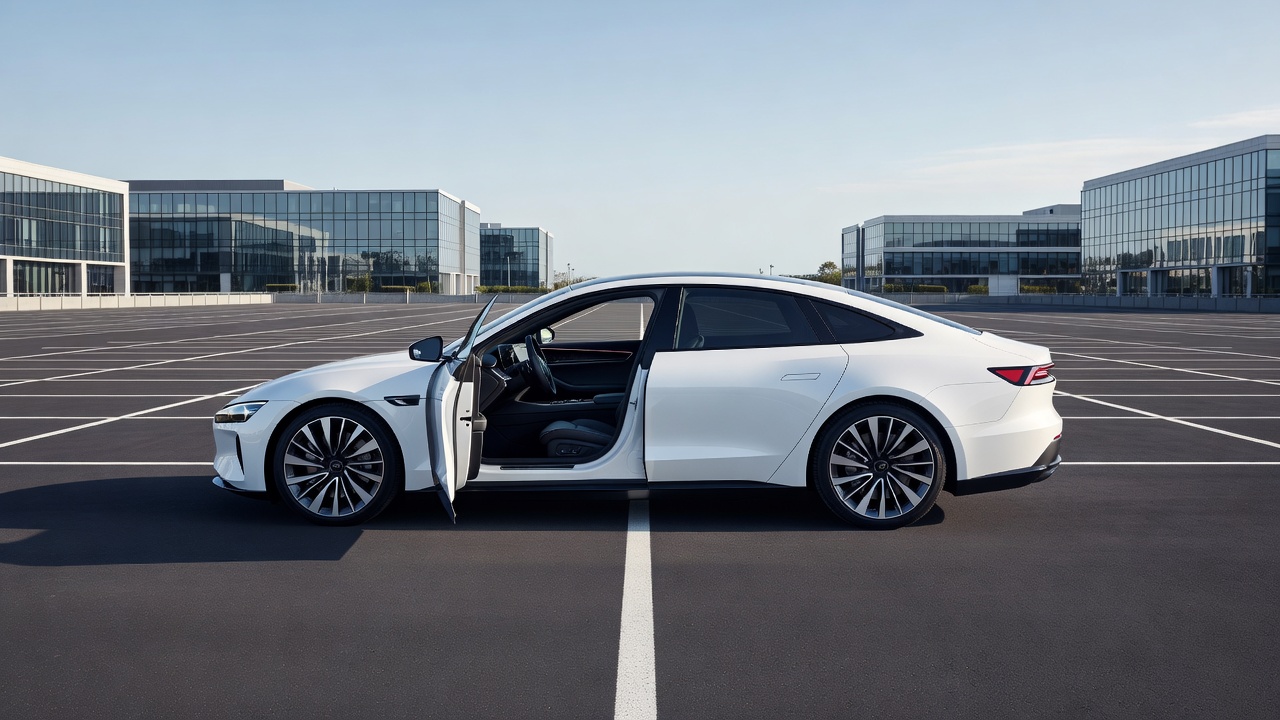
Lucid Motors' CFO is out as its new CEO continues leadership shakeup
Silvio Napoli hasn't wasted a minute. Barely weeks into the top job at Lucid Motors, the former Stellantis executive is wielding the knife with a ruthlessness that makes his predecessor's tenure look like a slow-motion retirement party. The departure of CFO Taoufiq Boussaid — announced alongside a wholesale replacement of the entire C-suite — isn't just a changing of the guard. It's a declaration that the Saudi-backed EV maker's first act is over, and the second act had better be profitable.
The SPAC hangover persists
Let's recall how we got here. Lucid went public via a 2021 reverse merger with Churchill Capital IV, one of the most hyped SPAC deals of that frothy era. The pitch was seductive: Peter Rawlinson, the engineer behind the Model S, would build a "Tesla killer" with proprietary technology and Saudi Arabia's seemingly bottomless Public Investment Fund backing. The stock hit $57. The reality? A production hellscape, demand that never materialized at price points north of $80,000, and a share price that now trades below $3.
Rawlinson's abrupt dual resignation as CEO and CTO in February 2025 — after a year-long search for his replacement — told you everything about the board's confidence. Napoli, a manufacturing operations veteran who ran Stellantis' Europe division, was brought in to do one thing: make the factory math work.
Simplification is a euphemism
"Simplify the company," Napoli said Thursday. "Sharpen execution." Corporate speak for: we're burning too much cash on too few cars. The numbers are brutal. Q2 deliveries of 3,953 vehicles — barely up from a year ago — confirm that the Gravity SUV launch has flopped. Meanwhile, Rivian raised its 2026 forecast the same day. The contrast is damning.
Lucid's response: eliminate a second factory shift in Arizona, cut hundreds of jobs (the second major round this year), and chase $158 million in annual savings. That's not simplification. That's survival.
The revolving door at the top
Boussaid's exit after less than two years as CFO is the headline, but the scale of the purge is the story. In a single day, Lucid announced five new C-suite hires: CFO, CTO, chief customer officer, chief digital officer, and chief transformation officer. The last title alone should worry shareholders — "transformation officer" is what companies hire when they don't know what they're transforming into.
Napoli is also halving his direct reports. This is classic turnaround playbook: centralize authority, install loyalists, eliminate dissent. But Lucid isn't a traditional automaker with decades of institutional knowledge to fall back on. Its institutional knowledge was Rawlinson and his engineering lieutenants. Most are gone.
The Cosmos gamble
Everything now rides on Cosmos, the sub-$50,000 midsize SUV slated for late 2026. This is Lucid's Model Y moment — or its Model X moment, if the execution falters. The company's proprietary 900-volt architecture and industry-leading efficiency are real technological advantages. But advantages don't pay the light bill. Volume does.
Can Napoli deliver volume? His Stellantis track record suggests he can run a production system. But Stellantis had scale, dealer networks, and a portfolio of profitable ICE vehicles funding the transition. Lucid has none of those. It has a single factory running at a fraction of capacity, a balance sheet propped up by Saudi patience, and a brand that sells aspiration but delivers niche.
Robotaxis: distraction or lifeline?
Then there's the Uber-Nuro robotaxi partnership — a luxury autonomous service launching in San Francisco this year, Houston in 2027. It's a compelling narrative for investors who want to believe Lucid is a tech company, not a car company. But Waymo has spent billions and years perfecting autonomy in San Francisco. Nuro's track record is delivery bots, not passenger vehicles. And Uber's autonomy strategy has been, charitably, inconsistent.
This smells like a story told to keep the stock from delisting while the real work — building Cosmos profitably — happens elsewhere. Or doesn't.
The Saudi question
Underpinning all of this is the Public Investment Fund, which owns roughly 60% of Lucid and has committed billions more. The kingdom wants a domestic EV champion. It wants technology transfer. It wants Neom to have luxury robotaxis. What it doesn't want is an endless cash furnace.
Napoli's mandate is almost certainly time-boxed. Show a path to breakeven on Cosmos. Prove the factory can run at 70%+ utilization. Demonstrate that the refreshed leadership team can execute without Rawlinson's technical authority. If he can't, the next shakeup won't be the C-suite. It'll be the ownership structure.
Accountability theater
"Enforcing accountability," Napoli promised. Fine words. But accountability in the auto business means hitting launch dates, achieving yield targets, and converting reservations to deliveries. Lucid has failed at all three repeatedly. A new org chart doesn't fix a broken demand curve.
The company's statement claims the "caliber of leaders joining is a testament to the inherent value of our business." Translation: we paid them well to take a risk on a company that might not exist in its current form in three years.
Lucid's technology is genuine. Its efficiency numbers shame the industry. But the auto business doesn't reward the best engineering — it rewards the engineering that reaches customers at scale. Napoli knows this. His flurry of hires and cuts suggests he's done pretending otherwise.
The next twelve months will tell us whether Lucid becomes a real automaker or a cautionary footnote in the SPAC era. The CFO is gone. The clock is ticking. And the Saudi patience, while deep, is not infinite.