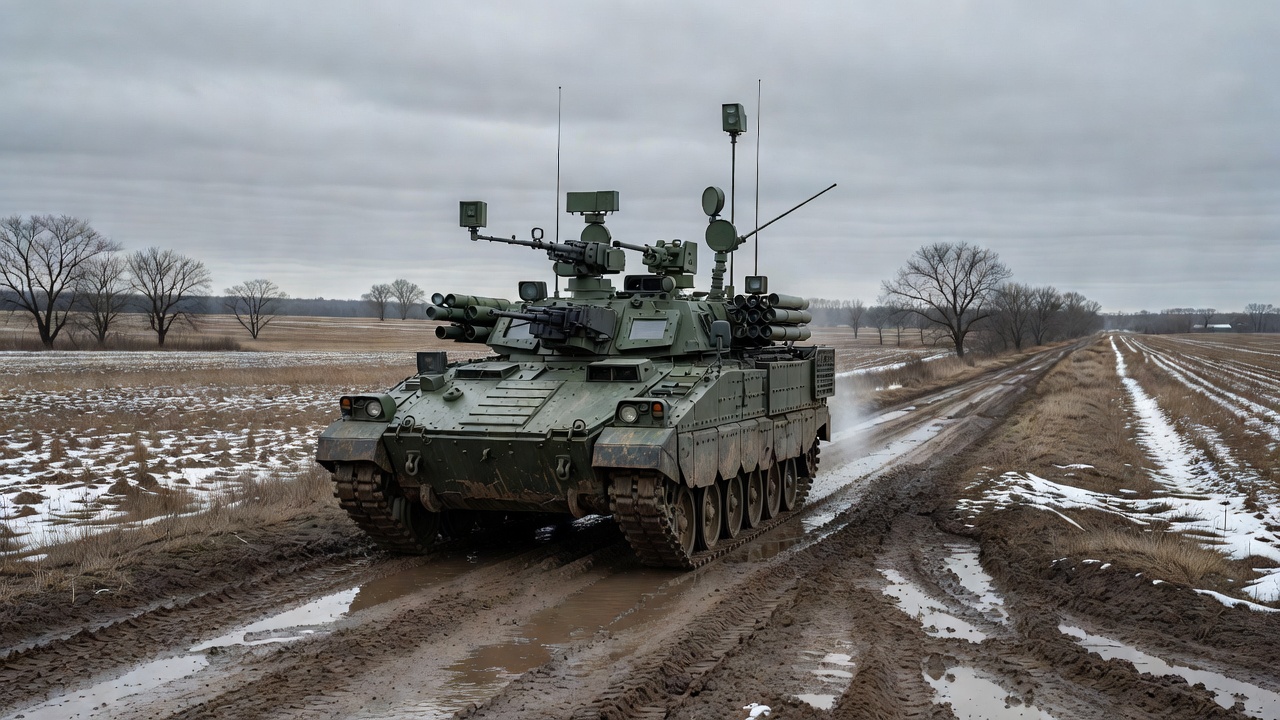
The first American autonomous ground vehicles are fighting in Ukraine
Digital Frontier EditorialJuly 7, 20266 min read
Key Takeaways
Forterra has deployed over 100 autonomous ATVs in Ukraine for nine months — the largest combat deployment of US autonomous ground vehicles in history.
Gas-powered Lancers haul 750 kg, triple the capacity of Ukraine's battery UGVs, and have moved 777,000 pounds across 1,100 missions including 52 casualty evacuations.
A Starlink antenna turned Pentagon-grade tech into battlefield gold — Ukrainian troops went from skepticism to demanding more.
Mud remains the enemy: vehicles stuck in deep terrain become sitting ducks for Russian targeting, teaching brutal lessons about autonomy's physical limits.
One hundred sixteen autonomous all-terrain vehicles have spent the last nine months hauling ammunition, evacuating wounded, and learning to survive Russian electronic warfare in Ukraine. Forterra, the Colorado company that builds them, believes this is the largest combat deployment of American autonomous ground vehicles ever. The Pentagon funded the experiment. Ukraine provided the laboratory. The results are measured in mud, blood, and 777,440 pounds of cargo moved.
This is not the future of war. This is war right now.
Aerial drones dominate the headlines. They created a transparent battlefield where movement attracts death from above. That pressure forced Ukrainian strategists to seek ground autonomy — not for flashy offensive strikes, but for the grinding logistics that keep positions alive. Sergeant Major Corey Wilkens, who runs the Army's autonomous vehicle program, put it bluntly: "There's nowhere to hide." A soldier on foot becomes a target for FPV drones, artillery, mortars. A robot carrying 750 kilograms of shells or a casualty stretcher changes that calculus.
Ukraine already builds its own uncrewed ground vehicles. They run on batteries and max out at 250 kilograms. Useful for short hops. Useless for sustained supply runs. Forterra's Lancer — a Polaris ATV wrapped in a custom sensor and compute stack — burns gasoline. That difference matters. Range. Payload. Endurance. A Ukrainian soldier who has operated both systems didn't mince words: "It's fucking fantastic, and we are dying to get more."
He didn't feel that way in October.
Western contractors arrive in Ukraine with regularity. Many bring solutions tailored to Pentagon requirement documents, not trench reality. Forterra's first iteration felt like that — high-end, Army-spec, fragile. Then someone bolted a Starlink antenna to the rack. Satellite connectivity let operators update software from Poland, push new electronic warfare countermeasures overnight, and maintain command links when Russian jammers drowned local radios. The vehicle transformed from a liability into a force multiplier.
Adapt or die. The cliché survives because it's true.
Since October, the fleet has logged 2,500 miles across 1,100 missions. Fifty-two casualty evacuations. Some vehicles have been lost — not to direct fire, but to mud. Deep terrain traps them. Russian forces then take their time destroying stuck assets. Autonomy solves navigation. It does not solve physics. No algorithm extracts a 2,000-pound machine from suction mud faster than a tracked recovery vehicle that doesn't exist in the sector.
Forterra is learning. Electronic warfare signatures. Remote software deployment cycles. Mechanical failures that only appear after weeks of vibration and cold. These are lessons no proving ground in Arizona can teach. Scott Sanders, the company's chief growth officer and a former Marine, knows the history: "I believe this to be true of every defense technology that's ever been created — until you hit the realities of combat, you're just not going to know."
The Pentagon watches. It takes notes. It funds the next iteration.
But the deeper story is uncomfortable. The world's most powerful military is outsourcing its autonomous ground combat validation to a proxy war. American robots are fighting — and dying — in Ukrainian mud because the US Army has not fielded them at scale in its own formations. The safety reviewers, the acquisition milestones, the requirements creep — they all dissolved when Ukraine said yes. Forterra moved fast because the customer had no choice.
That should embarrass the defense establishment.
Ukraine has become the world's most rigorous test range for ground autonomy. Not because the technology is mature. Because the need is existential. Battery UGVs handle the last 500 meters. Gas-powered Lancers handle the five kilometers before that. Together they stitch a logistics chain that human drivers can no longer sustain under persistent surveillance. The division of labor emerged organically. No doctrine manual prescribed it.
Casualty evacuation changes the moral weight. Fifty-two times, a machine drove into fire zones and carried a bleeding human out. No risk to a driver. No hesitation. The robot does not feel fear. It also does not feel compassion. It executes a mission profile. The distinction matters when the algorithm misclassifies a crater or loses localization in a smoke screen.
Forterra has raised more than $100 million. The Ukraine deployment validates the investment. It also creates a data moat — 2,500 miles of combat telemetry that no competitor possesses. The company now knows what electronic warfare looks like at 3 a.m. in January near Bakhmut. It knows which suspension bushings fail after 300 kilometers of shell-pocked roads. It knows how to patch autonomy software over Starlink while the vehicle sits 20 kilometers behind Russian lines.
That knowledge is proprietary. The Pentagon paid for the vehicles. Ukraine paid in blood. Forterra owns the lessons.
Future conflicts will not wait for acquisition cycles. The next war — Taiwan, the Baltics, somewhere unnamed — will feature autonomous ground vehicles on day one. They will carry supplies. They will evacuate wounded. They will get stuck in mud and become targets. The side that has already learned those lessons in Ukraine wins the learning curve.
America is learning through Forterra. The question is whether the Army can institutionalize those lessons before the next deployment. Bureaucracy moves at the speed of paperwork. Combat moves at the speed of FPV drones.
One hundred sixteen vehicles. Nine months. 777,440 pounds. Fifty-two lives moved out of kill zones. The first American autonomous ground vehicles are not coming. They are here. They are burning gas in Ukrainian mud. They are teaching the hardest lessons in the most unforgiving classroom on Earth.